It Sound Hard Pop for Blue Trees Review
| "Bullet the Blue Sky" | |
|---|---|
| Vocal by U2 | |
| from the album The Joshua Tree | |
| Released | 9 March 1987 |
| Recorded | 1986 |
| Genre | Post-punk[i] |
| Length | 4:32 |
| Label | Island |
| Composer(s) | U2 |
| Lyricist(due south) | Bono |
| Producer(s) |
|
"Bullet the Bluish Sky" is a song by Irish gaelic rock ring U2, and is the fourth track from their 1987 anthology The Joshua Tree. Lyrically, the vocal was inspired by a trip that lead singer Bono made to Nicaragua and El salvador, where he saw firsthand how local peasants were affected by United States military intervention in the region. Angered by what he witnessed, Bono asked guitarist the Border to "put El salvador through an amplifier." "Bullet the Blueish Sky" is one of the band's near overtly political songs, with alive performances often being heavily disquisitional of political conflicts and violence.
Writing and recording [edit]
"Bullet the Blue Sky" start originated as a demo that U2 recorded during a jam session at STS Studios in Dublin with producer Paul Barrett, prior to the proper Joshua Tree recording sessions.[2] While listening to a song by English rock band the Fall, U2 guitarist the Edge tried to emulate its guitar riff, but instead came up with his own part that was, in his approximation, "uptempo, like existent hard-hitting". Information technology somewhen became the chorus for "Bullet the Blue Sky".[3] Bassist Adam Clayton and drummer Larry Mullen Jr. then joined in playing at one-half-time.[two] [4] Lead vocalist Bono recalled that Clayton was also playing in a different key from the Border.[2] The guitarist became irritated, every bit the rhythm department was playing much differently than how he idea they should.[three] He idea to himself, "What the fuck are they doing?", and considered stopping the jam.[2] After the have was completed, the band listened to playback in the control room and realised that the demo was "absolutely brilliant".[2] Compared to the final version of the song, the Border described the demo every bit "much more blank-boned, like a heavy funk track".[5] Still, the song was discarded for some time until producer Brian Eno, who described it as a "homeless riff", convinced the band it was worth working on.[6]
In July 1986,[seven] Bono and his wife Ali travelled to Nicaragua and Republic of el salvador, where they saw firsthand the distress of peasants bullied past political conflicts and Usa military intervention. The trip angered Bono and formed the basis of the song's lyrics.[5] [8] He said, "I remember the ground shaking, and I remember the smell, I suppose, of beingness near a war zone. I don't think we were in danger, simply I knew there were lives in danger or being lost shut to usa, and I felt for them. It upset me as a person who read the Scriptures, to think that Christians in America were supporting this kind of matter, this kind of proxy war because of these Communists."[9] [x] In August, after reconvening with his bandmates in Dublin to resume work on The Joshua Tree,[xi] Bono instructed the Edge to "put Republic of el salvador through an amplifier", resulting in the song's feedback-based guitar part.[12] [13] The Edge said that his guitar playing was as well informed by Bono's lyrics.[5]
Producer Daniel Lanois says that the most progress on "Bullet the Blue Heaven" was made at Melbeach, the Border's newly purchased domicile in seaside Monkstown.[xiv] According to Lanois, the song'south performance came from a 20-infinitesimal jam that he defended an extensive amount of fourth dimension to editing into a concluding organisation, "for a vocal that was never a vocal, that was only ever a jam." He said, "It was one of those songs that was born partially by surgery – the editing of the structure was a actually big office of it."[fifteen] Recording engineer Dave Meegan helped develop the song with a mix that he made at Melbeach. Wanting it to audio similar Led Zeppelin, Meegan adjusted a monitor mix to make it "really heavy sounding." Lanois was inspired by what he heard, as the song up to that betoken was being treated softly.[thirteen] He rapidly summoned the band,[xiii] who went with the primary engineer Overflowing to Windmill Lane Studios.[15] There, in a warehouse next door, the crew used a public address system to play an audio-visual recording of Mullen'due south drums, which was then re-recorded inside the warehouse.[16] Lanois called information technology a "actually elaborate kind of rock and gyre bedroom".[15] The result, according to Meegan, "made [the drums] audio similar John Bonham",[thirteen] while Lanois said they sounded "tankier".[16] He added, "it introduced a mid-range that the high-chapeau seemed to like. This new sonic emphasis on the loftier-hat fabricated every hit more relevant... The inherent low-frequency dial of the PA also added a level of excitement to the bass drum. The overall sensation was a chestier one."[16]
The last mix of "Bullet the Blue Sky" was based on two unlike versions. Producer Steve Lillywhite, who in December 1986 was hired by U2 to help mix some of The Joshua Tree,[17] was asked by the Edge "to fly over from one version to another version". Without admission to modernistic day samplers at the time, Lillywhite had to lucifer the tempos of the two tape recordings by hand then, during playback, transfer the requested sections of each onto a one-half-inch tape recorder. He said information technology "was never all played at the aforementioned time; it was a existent mish-mash of two things."[18] Lanois said Lillywhite's terminal mix was much different from his and Eno's version, leaning more heavily on effects and overdubs: "I wouldn't have had as many effects on it, considering nosotros had a scrap of a purist attitude toward some of these recordings, essentially that in that location was a sound that was captured in operation in a room, and we wanted to remain loyal to that space, to convey that sound. And he was non as sentimental to that idea, then he pulled out all the stops."[xix]
During a spoken word passage of the vocal, Bono speaks of beingness approached past a man, "his confront cherry-red like a rose on a thorn bush, like all the colours of a royal flush, and he's peeling off those dollar bills, slapping them downwardly, 100, 200". Bono said the person he had in mind while writing the lyrics was then US President Ronald Reagan, whose administration backed the military regimes in Fundamental and Southward America that Bono encountered on his before trip. The lyrics were partially inspired by Bono seeing a mural in El Salvador of Reagan in a chariot depicted as the Pharaoh, with Salvadorans as "the children of State of israel running away".[4]
Live performances [edit]
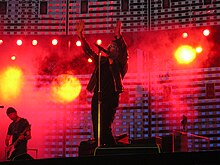
A functioning of the song on the Vertigo Bout, when the ring re-interpreted it every bit a commentary on religious violence.
"Bullet the Blue Heaven" was played at nearly every live concert from its kickoff performance at the opening dark of the Joshua Tree Tour on 2 April 1987 through the Vertigo Tour. Its live performances have traditionally been paired with "Running to Stand Still"; this took identify on the Joshua Tree Tour, Lovetown Bout, Zoo TV Tour, and the offset 46 concerts of the Vertigo Tour. On the PopMart Bout, "Bullet" instead led into "Delight"; Pinnacle Bout performances were followed by "With or Without You" or a cover of "What'due south Going On" by Marvin Gaye; on the Vertigo Tour, "Miss Sarajevo" replaced "Running to Stand Still" for the last 85 concerts.[20] and on the Innocence + Experience Tour, it segued into "Pride (In the Name of Honey)" on the first leg and an abbreviated version of "Zooropa" starting on the 2nd leg.
During the Joshua Tree Tour, Bono would oftentimes catch a large spotlight and shine into peoples' faces in the audience, and would also make numerous political references to figures such equally Ronald Reagan and Jerry Falwell. He also used the spotlight on the Elevation Tour. On the Innocence + Experience Tour, Bono would typically sing the majority of the vocal into a megaphone.
U2'due south following anthology, Rattle and Hum, featured a live performance of this song, with a pre-recorded intro of Jimi Hendrix's version of "The Star-Spangled Banner". "Bullet" then took on new meanings throughout the subsequent years. On the Zoo Telly Tour, information technology was near Nazism; on the PopMart Tour, it, at least on occasion, featured references to consumerism and rock iconography in keeping in with the tour's theme. On the Elevation Tour, it became an indictment against handgun violence, illustrated past references to John Lennon's assassination and an ironic intro video prune featuring Charlton Heston, who was at that time the president of the National Burglarize Association, while on the Vertigo Tour, it was virtually religious violence and the terminal lyrics were replaced by a snippet of "The Easily That Built America".[20] On the Innocence + Feel Tour, the song was near corruption of coin, which was emphasized with images of Wall Street and Las Vegas on the video screen, as well as Bono discussing a scenario where he meets a teenage version of himself who criticizes the wealthy man he has become.
The Edge uses his black Fender Stratocaster to play this vocal, except during the PopMart Tour, when he used a Gibson Les Paul.
Alive performances of the vocal announced on the concert films Zoo Tv: Live from Sydney, PopMart: Alive from Mexico Metropolis, Superlative 2001: Live from Boston, U2 Go Habitation: Live from Slane Castle, Ireland, Vertigo 2005: Live from Chicago, Alive from Paris and Innocence + Feel: Live in Paris.
Reception and cover versions [edit]
In 2004, Mojo placed the vocal at number 17 on its list of the "100 Epic Rock Tracks".[21] The September 2018 consequence of Q included the song on a list of the "50 Greatest Revolutionary Songs"; author Niall Doherty said, "It's no footling irony that it became the about powerful vocal on the album that made U2 stars in America, Bono serving up this tale of the horrors of US foreign policy to packed stadiums, night after nighttime."[22]
The U2 Podcast Editions in iTunes mentions that this is Paul McGuinness' (one-time U2 manager) favorite vocal.
The song is covered by Sepultura in their covers EP Revolusongs, by P.O.D. in their album The Fundamental Elements of Southtown and Queensrÿche in their album Take Cover.
Encounter too [edit]
- Ronald Reagan in music
- Listing of anti-war songs
- List of covers of U2 songs – "Bullet the Blue Sky"
References [edit]
Footnotes
- ^ Pareles, Jon (15 May 2017). "Review: U2 Revisits 'The Joshua Tree' in the Here and Now". The New York Times . Retrieved 8 June 2017.
- ^ a b c d e McCormick (2006), p. 172
- ^ a b Eccleston, Danny (7 July 2017). "U2: Inside Their Joshua Tree Bout". Mojo . Retrieved vii July 2017.
- ^ a b Inskeep, Steve (twenty March 2017). "U2 On 'The Joshua Tree,' A Lasting Ode To A Divided America". NPR Music. National Public Radio. Retrieved 20 March 2017.
- ^ a b c McCormick (2006), pp. 178–179
- ^ Sandall, Robert (October 1990). "Back to the Futurity". Q. No. 49.
- ^ McGee (2008), p. 97
- ^ Dalton, Stephen (Oct 2003). "How the West Was Won". Uncut. No. 77.
- ^ Legaspi, Althea (20 May 2016). "See Bono Talk U2's 'Bullet the Bluish Sky' Origins in New Video". Rolling Stone . Retrieved 12 May 2017.
- ^ Crandell, Ben (9 June 2017). "U2'southward 'Joshua Tree' and America come up total circle". SouthFlorida.com. Dominicus-Sentinel. Retrieved 9 June 2017.
- ^ McGee (2008), p. 98
- ^ "U2". Legends. Flavor 1. Episode half dozen. 11 December 1998. VH1.
- ^ a b c d Jobling (2014), pp. 158–159
- ^ Runtagh, Hashemite kingdom of jordan (9 March 2017). "U2'south 'The Joshua Tree': x Things You lot Didn't Know". Rolling Rock . Retrieved 9 March 2017.
- ^ a b c O'Hare, Colm (28 November 2007). "The Secret History of 'The Joshua Tree'". Hot Printing. Vol. 31, no. 23. Archived from the original on 2 November 2011. Retrieved 27 April 2011.
- ^ a b c Lanois (2010), pp. 47–48
- ^ McCormick (2006), pp. 184–185
- ^ Rex, Philip, and Nuala O'Connor (directors) (1999). Classic Albums: U2 - The Joshua Tree (Television documentary). Isis Productions.
- ^ Henke, James (17–31 December 1987). "Q&A: Daniel Lanois". Rolling Rock. No. 515/516. Retrieved 23 June 2017.
- ^ a b "Alive performance history of 'Bullet the Blue Sky". u2-vertigo-tour.com.
- ^ "100 Epic Rock Tracks". Mojo (125). April 2004.
- ^ "50 Greatest Revolutionary Songs". Q. September 2018. p. 59.
Bibliography
- Jobling, John (2014). U2: The Definitive Biography . New York: Thomas Dunne Books. ISBN978-ane-250-02789-4.
- Lanois, Daniel (2010). Soul Mining: A Musical Life . New York: Faber and Faber. ISBN9780865479845.
- McGee, Matt (2008). U2: A Diary. London: Autobus Press. ISBN978-1-84772-108-2.
- U2 (2006). McCormick, Neil (ed.). U2 past U2 . London: HarperCollins. ISBN0-00-719668-7.
Source: https://en.wikipedia.org/wiki/Bullet_the_Blue_Sky

Post a Comment for "It Sound Hard Pop for Blue Trees Review"